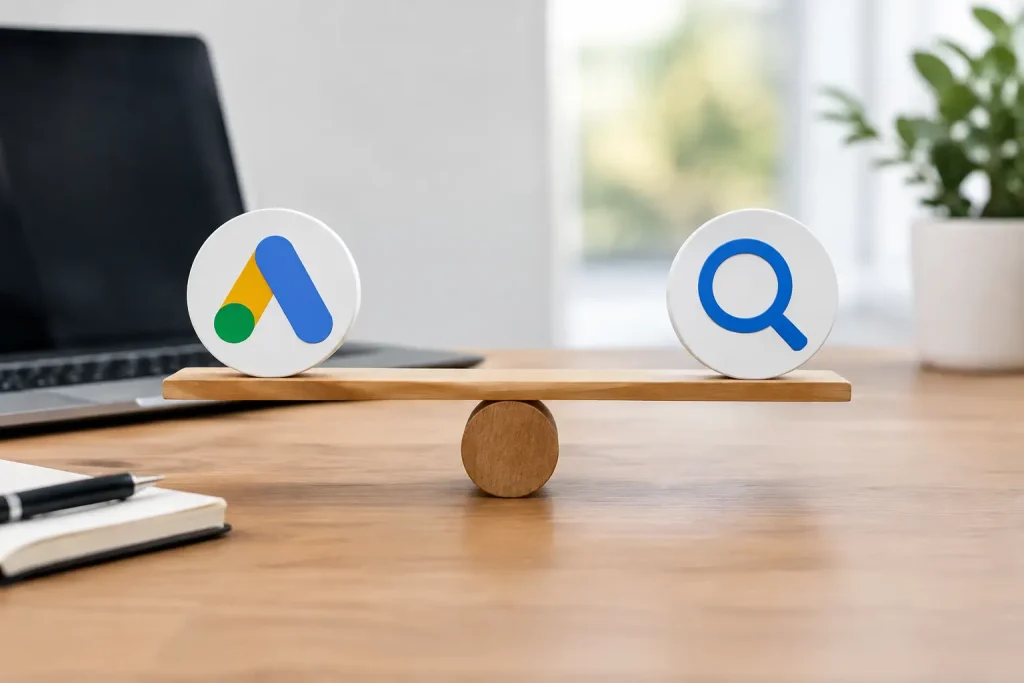
A founder launches a paid campaign on Monday, sees traffic by Tuesday, and wonders why organic search deserves another dollar. Then the campaign pauses, the traffic disappears, and the answer gets clearer. PPC versus SEO is not a choice between two ways to get website visitors. It is a decision about how your business creates demand now while building an asset that compounds later.
For growth-oriented businesses, the right answer is rarely “pick one and ignore the other.” The more useful question is: what does your company need at this stage, and can your website turn attention into qualified conversations once it arrives?
PPC Versus SEO: The Core Difference
PPC, or pay-per-click advertising, buys placement. You bid to appear in search results, social feeds, or other digital channels, and you pay when someone clicks. It can create visibility quickly, provided the audience, offer, budget, and landing page are aligned.
SEO, or search engine optimization, earns visibility. It improves the technical health of your site, clarifies what you offer, builds useful content around real buyer questions, and strengthens credibility signals that help search engines trust your brand. It takes longer to establish, but a strong organic presence can continue generating qualified demand without charging you for every visit.
That distinction matters because paid traffic is rented. Organic visibility is earned equity. Neither is automatically better. A well-funded PPC campaign can waste money just as efficiently as an unfocused SEO program can waste months.
When PPC Is the Right Growth Lever
PPC is built for speed, control, and testing. If you have a time-sensitive offer, a new service launch, an event, a limited geographic market, or a clear need for leads this quarter, paid search can put your business in front of high-intent prospects quickly.
It also gives founders a useful testing environment. You can test whether people respond to a service angle, a pricing message, a call to action, or a category of keywords before investing heavily in long-form content and organic pages. If prospects consistently click but do not convert, the issue may not be your traffic source. It may be your positioning, offer, or website experience.
PPC works especially well when the purchase path is direct. A local service company with clear demand, a B2B firm promoting a focused consultation, or a founder with a proven offer can use paid campaigns to create a predictable flow of opportunities.
The trade-off is cost and durability. Competitive keywords can become expensive. Performance can shift with platform changes, competitor bids, and audience fatigue. More importantly, the moment you stop paying, your placement usually stops too. PPC should produce insight and revenue, not become a permanent substitute for a credible digital presence.
PPC requires conversion infrastructure
Sending paid clicks to a generic homepage is one of the fastest ways to turn ad spend into a vague marketing expense. A campaign needs a landing experience that matches the promise of the ad, explains the outcome clearly, addresses objections, and gives visitors a confident next step.
Before increasing budget, look at the full path: keyword or audience, ad message, landing page, form or booking flow, follow-up speed, and sales process. Click-through rate is not business growth. Qualified pipeline is.
When SEO Is the Better Investment
SEO is the right long-term lever when customers search for the problems you solve, when trust matters before a sale, and when your business intends to own a category rather than merely appear in it occasionally.
For professional services, executive brands, established local companies, and B2B firms with longer buying cycles, organic search often does more than generate visits. It establishes authority before the first call. A prospect who finds a thoughtful service page, relevant case evidence, and clear answers to their questions arrives with more confidence than someone who clicked a generic ad with no supporting substance.
The return from SEO is rarely immediate. Early work may involve correcting technical issues, refining site structure, improving core pages, researching buyer language, and creating content that deserves to rank. Search engines need time to crawl, interpret, and validate those improvements. In competitive categories, that timeline can be substantial.
But patience should not be confused with passivity. A disciplined SEO strategy has leading indicators: better indexing, stronger rankings for commercial topics, growing impressions, more qualified organic visits, and improved conversion paths. The goal is not traffic for its own sake. The goal is to become easier to find and easier to choose.
SEO is broader than blog publishing
Many businesses treat SEO as a monthly content quota. That approach produces plenty of pages and very little market movement. Search performance depends on the entire system: site speed, information architecture, service-page quality, local relevance where applicable, content depth, internal pathways, brand credibility, and conversion design.
A five-page website with vague headlines and disconnected services will struggle even if it publishes articles regularly. Strong SEO starts by making the business legible to both search engines and buyers. What do you do? Who is it for? Why should someone trust you? What should happen next?
How Cost Changes the PPC Versus SEO Decision
PPC has a visible cost structure. You set a budget, pay for clicks, and can usually see near-term spend against inquiries or revenue. That visibility is valuable, but it can create a false sense of certainty. If your cost per lead is acceptable while lead quality is weak, the campaign is not efficient. It is simply measurable.
SEO costs more in strategy, implementation, and consistency upfront. The investment may cover website improvements, content development, technical work, and ongoing optimization. Its economics become more attractive when the pages and authority you build keep producing results over time.
Think of PPC as a demand capture tool with an ongoing media bill. Think of SEO as a business asset with an upfront build phase and ongoing maintenance. Your cash flow, sales cycle, margins, and internal capacity should influence the mix.
A business with a high-value client relationship may justify higher acquisition costs because one new client can fund months of marketing. A lower-margin company may need organic growth to reduce dependency on paid channels. There is no universal benchmark that replaces sound unit economics.
Use Both Channels to Make Each Other Stronger
The strongest approach is often sequential, not simultaneous at full intensity. Use PPC to learn quickly, then use those lessons to sharpen SEO. Paid search data can reveal the phrases prospects use, the offers that earn attention, and the questions that signal purchase intent. Those insights can inform service pages, website messaging, and content priorities.
At the same time, a strong SEO foundation makes PPC more effective. Better landing pages, clearer positioning, stronger trust signals, and a more coherent website improve the odds that paid visitors will convert. You pay less waste tax when your digital house is in order.
A practical allocation might begin with focused paid campaigns around your highest-intent services while building the organic pages that support your core market. As organic visibility grows, PPC can shift toward launches, retargeting, competitive terms, testing, and seasonal demand rather than carrying the entire lead-generation burden.
Make the Decision Based on Business Readiness
Choose PPC first when you need immediate market feedback, have a validated offer, can fund testing, and have a sales process ready to respond. Choose SEO first when your website lacks authority, your category depends on trust, your buying cycle involves research, or you are building for sustainable visibility over the next 12 to 24 months.
If the business is not ready to convert attention, fix that before scaling either channel. A clear offer, a credible website, fast lead follow-up, and a defined conversion path are foundational. Marketing cannot compensate indefinitely for a confusing digital presence.
Everstrong Media approaches this work as growth infrastructure, not a channel checklist. Some teams need to build internal capability. Others need a strategic partner to co-build the system, or a full-service team to own execution. The right model is the one that creates momentum without leaving your business dependent on tactics you cannot sustain.
The better question is not whether PPC or SEO wins. Build the channel that solves your most immediate constraint, then invest in the one that makes your growth less fragile. A business built to last should be able to generate demand today and earn trust long after the campaign budget has been spent.