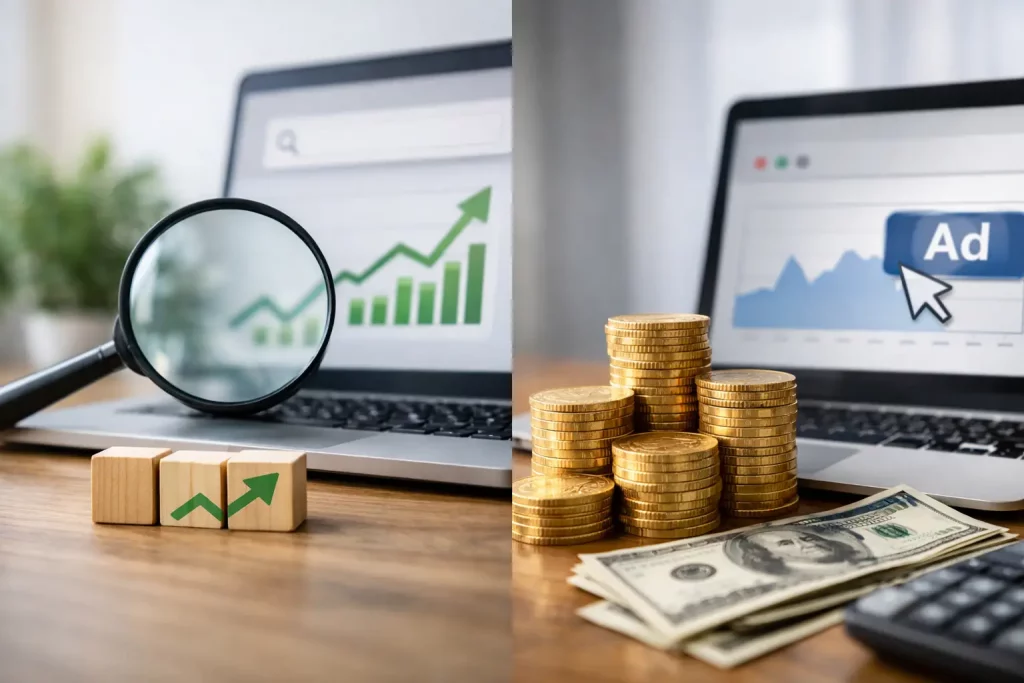
A founder launches a new offer, turns on ads, sees clicks by Friday, and assumes the growth engine is working. Then the campaign pauses, lead flow drops, and the website goes quiet again. That is the real tension in seo vs paid traffic – speed versus staying power, short-term demand capture versus long-term visibility that compounds.
For most businesses, this is not a philosophical marketing debate. It is a budgeting decision with real consequences. Where do you put dollars if you need leads now, but you also want a brand that means something six months from now? Where do you invest if your website is supposed to function like a revenue asset, not a digital brochure?
The right answer is rarely all SEO or all paid media. It depends on your timeline, your margins, your offer, and the strength of your digital foundation.
SEO vs Paid Traffic: The Core Difference
SEO earns visibility. Paid traffic rents it.
That distinction matters more than most businesses realize. Search optimization improves your ability to show up when buyers are actively looking for answers, providers, or solutions. If done well, it builds equity. Your content, site structure, authority, and conversion paths keep working after the month ends.
Paid traffic works differently. You pay to place your message in front of a target audience through search ads, social ads, display, retargeting, or sponsored placements. It gives you speed, control, and immediate testing power. But the minute you stop spending, the traffic stops too.
Neither channel is automatically better. SEO typically lowers acquisition costs over time, but it takes patience and execution discipline. Paid traffic creates faster data and quicker lead opportunities, but costs can rise fast if the offer, funnel, or audience targeting is weak.
When SEO Wins
SEO is the stronger investment when your business needs durable visibility and trust at the same time.
If you are a service business, consultant, law firm, local brand, or B2B company with a considered buying cycle, search often plays an outsized role. People research before they buy. They compare providers. They look for proof, authority, and relevance. A well-structured site with strong search positioning does more than attract clicks. It pre-sells the relationship.
This is especially true for founders and executive-led brands. If your name, your point of view, and your expertise influence the sale, SEO helps your market discover those signals consistently. Thoughtful service pages, brand positioning content, and educational articles create a footprint that paid ads alone cannot fully replace.
SEO also wins when efficiency matters. Organic traffic is not free – it takes strategy, technical work, content development, and ongoing refinement – but it can become far more cost-effective than paid acquisition over time. Once rankings stabilize and pages convert, the economics improve.
There is a trade-off. SEO is slower. If your site is weak, your messaging is muddy, or your market is highly competitive, meaningful traction can take months. Businesses that expect instant return usually abandon SEO before it has a chance to work.
SEO works best when:
Your offer has ongoing demand, your margins support long-term investment, and your website is capable of converting qualified traffic once it arrives.
If any of those pieces are missing, SEO can still help, but it will not carry the full growth burden by itself.
When Paid Traffic Wins
Paid traffic wins when time matters more than compounding.
If you are launching a new offer, entering a new market, promoting an event, or trying to validate messaging quickly, paid media gives you immediate reach. You can test headlines, audiences, landing pages, and pricing in days instead of waiting months for organic visibility to build.
This makes paid traffic especially useful for companies that need fast feedback. You may not know which value proposition resonates. You may not know whether buyers respond better to founder-led messaging or service-led messaging. Paid campaigns can generate the data that shapes the broader strategy.
It is also effective when search demand is limited but audience targeting is strong. Some buyers are not actively searching yet. Paid social can put an offer in front of the right people before intent shows up in Google.
But paid traffic has its own discipline. It exposes weak positioning quickly. If the landing page is unclear, if the offer lacks urgency, or if your website does not build trust fast enough, paid media becomes expensive education. You get traffic, but not revenue.
Paid traffic works best when:
You have a clear offer, a defined conversion path, and enough budget to test without panicking after the first week.
Paid media is not just about spending money. It is about buying speed while your team learns what the market responds to.
SEO vs Paid Traffic for Different Growth Stages
Early-stage businesses often assume paid traffic is the obvious answer because it is faster. Sometimes that is true. But speed without infrastructure wastes capital.
If your brand positioning is still evolving, your website is underdeveloped, and your sales process is not yet consistent, aggressive ad spend can amplify confusion. In that stage, a smart approach is often to build core SEO pages and foundational brand assets while using limited paid campaigns to test demand.
For growth-stage businesses, the conversation changes. Once you know your audience and have some conversion history, combining SEO and paid traffic usually creates the strongest system. SEO captures high-intent demand and builds authority. Paid traffic accelerates lead generation, retargets interested visitors, and supports launches or seasonal pushes.
For established brands, SEO becomes even more valuable because authority compounds. A credible digital presence lowers friction in the sales process. Buyers search your company, your founder, your services, and your category before they commit. If your search footprint is thin, that absence creates doubt.
The Hidden Variable: Your Website
Most debates around seo vs paid traffic ignore the real issue. Traffic quality matters, but conversion architecture matters more.
A weak website can make both channels underperform. Organic visitors arrive and bounce because the messaging is vague. Paid visitors click but do not convert because the page feels generic or disconnected from the ad promise. In both cases, the channel gets blamed for what is actually a positioning and site performance problem.
This is why serious growth strategy starts with the asset itself. Your website should clarify the offer, establish authority, reduce friction, and guide action. It should support search visibility and paid campaign performance at the same time.
If it does not, you are not choosing between channels. You are choosing which leak to fund first.
A Smarter Budgeting Approach
The strongest brands do not ask which channel is universally better. They ask which channel solves the current constraint.
If you need leads in the next 30 days, paid traffic may deserve the larger share of budget. If your pipeline depends too heavily on referrals and inconsistent outbound activity, SEO may deserve more attention because it builds an owned discovery engine.
In many cases, the best move is staged investment.
Start by fixing the site, the messaging, and the conversion path. Then use paid traffic to test offers and generate immediate demand while building SEO assets that create compounding visibility. Over time, as organic traffic grows, paid media becomes more selective. It supports strategic campaigns instead of carrying the full load.
That is a healthier model. It gives you speed without permanent dependency.
SEO vs Paid Traffic: What Most Businesses Actually Need
Most founder-led and service-based businesses do not need a winner. They need coordination.
SEO without conversion strategy turns into a content library that attracts attention but not revenue. Paid traffic without brand authority turns into a constant fight against rising costs. Together, when aligned to the right offer and site experience, they create something stronger: discoverability, trust, and demand generation operating in sync.
This is where mature marketing starts to look different from random channel activity. It becomes infrastructure. The website works harder. Search builds authority. Ads create momentum. Founder visibility supports both. At Everstrong Media, that is the standard – not isolated tactics, but digital systems built to drive growth and last.
If you are deciding where to invest next, resist the urge to chase what feels fastest or cheapest in the moment. Choose the channel mix that matches your stage, your economics, and the kind of brand you are actually trying to build. Quick wins are useful. Durable visibility is better. The businesses that scale well learn how to create both.